
How Many Shipping Containers Fit on an Acre? Layouts and Numbers
By The Unit Manager Pro Team · 20 November 2026 · 6 min read · Updated 20 November 2026
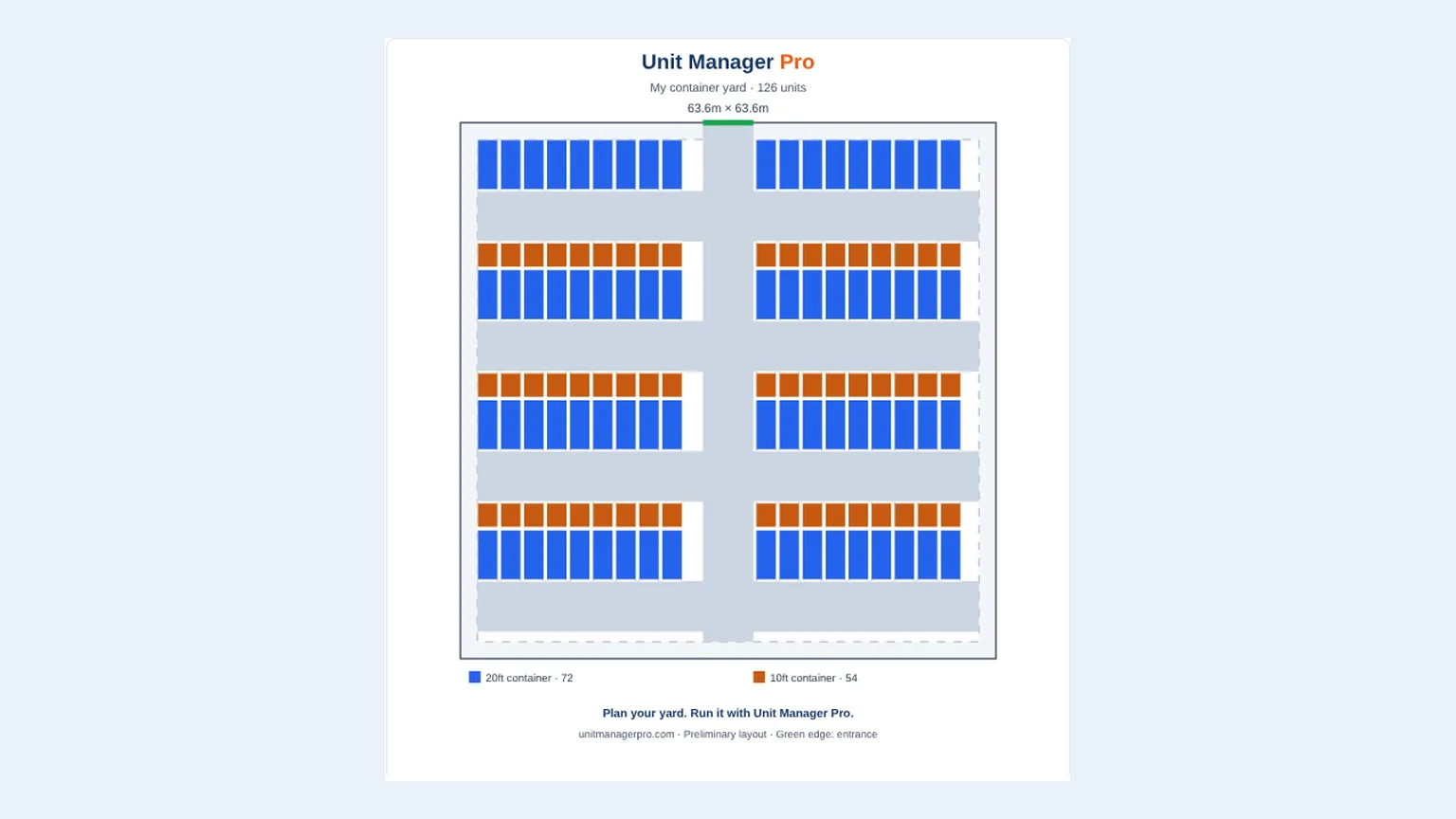
A square one-acre plot fits about 108 twenty-foot shipping containers, 162 ten-foot containers or 54 forty-foot containers, once you leave room for 6 m access aisles, a 2 m perimeter and a central gate. The exact number depends on the shape of your land, where the gate goes and the mix of sizes, so treat these figures as a starting point and draw your own site in the free [container yard planner](/tools/container-yard-capacity-calculator).
Containers per acre: worked examples
These layouts were produced by the Unit Manager Pro yard planner on square plots with its default settings: a gate in the middle of one side, a 2 m perimeter, 6 m aisles and 0.3 m between containers. The mix column uses the planner's default 70:30 split of floor area between 20ft and 10ft containers.
| Plot | 20ft only | 10ft only | 70:30 mix | 40ft only |
|---|---|---|---|---|
| ¼ acre (1,012 m²) | 12 | 24 | 18 (12 × 20ft, 6 × 10ft) | 6 |
| ½ acre (2,023 m²) | 48 | 72 | 60 (24 × 20ft, 36 × 10ft) | 24 |
| 1 acre (4,047 m²) | 108 | 162 | 126 (72 × 20ft, 54 × 10ft) | 54 |
| 2 acres (8,094 m²) | 224 | 364 | 280 (168 × 20ft, 112 × 10ft) | 140 |
- Small plots lose a large share of their area to the perimeter and the gate approach, which is why ¼ acre fits far fewer than a quarter of the one-acre figure.
- Doubling from one acre to two roughly doubles the count, because the aisles and perimeter take a smaller share of a larger site.
Container sizes and how much land they use
Standard shipping containers are 8 ft (2.44 m) wide. A 10ft container covers about 7.4 m², a 20ft about 14.9 m² and a 40ft about 29.7 m². One acre is 4,046.86 m², or 43,560 sq ft.
In the one-acre example, 108 twenty-foot containers cover about 1,605 m², roughly 40% of the plot. The other 60% is aisles, perimeter and gate approach. With 10ft containers only about 30% of the land is covered, because every container needs its own door onto an aisle.
What changes the number on your site
Two plots of the same area can hold very different numbers of containers. Check these before you rely on any per-acre figure.
- Plot shape: long, narrow or angled plots leave more unusable strips at row ends than a square.
- Gate position: a gate on a corner or a long side changes which rows can face an aisle. Try more than one position in the planner.
- Aisle width: wider aisles are easier for customers with vans or trailers but cost whole rows of containers.
- Exclusions: an office, customer parking, a turning head, drainage runs, trees or overhead lines all take space that containers cannot use.
- Container mix: all-10ft gives the most units; all-20ft or 40ft covers more of the ground. A mix lets you serve more customer sizes.
- Phasing: many operators place a first phase near the gate and expand as occupancy grows, which keeps early cash outlay lower.
How to plan your container yard, step by step
Work from a measured plan, not an estimate of the plot size. The planner keeps your drawing in your browser, so you can try several layouts before speaking to suppliers.
- Measure the usable plot and mark the entrance, boundaries and anything that cannot move.
- Choose the sizes you want to rent, based on what local customers ask for.
- Enter the plot in the container yard planner, set the gate and aisles, and compare layouts.
- Add exclusions for an office, parking and a turning area, then check how many containers remain.
- Switch on full costings to add container prices, groundworks, rents and running costs, and see the payback.
- Have a qualified designer check access, drainage, fire safety and planning requirements before you buy containers.
From layout to a working container storage business
Once the layout works, the next questions are cost and demand. The container storage startup cost checklist covers what to budget, and the shipping container storage business guide covers site, permissions and launch.
To check the numbers on an existing or planned facility, use the self storage profit calculator. When you are ready to take bookings, Unit Manager Pro lists each container on your own container storage website, takes online bookings and collects rent automatically. You only pay for containers that are let.
Turn your layout into a container storage business
List every container online, take bookings and collect rent automatically. Empty containers are free; start a 14-day free trial with no credit card.
Frequently asked questions
How many 20ft shipping containers fit on one acre?
About 108 on a square one-acre plot, using a central gate, a 2 m perimeter, 6 m aisles and 0.3 m between containers. A long, narrow or irregular plot, a side gate, or space for an office and parking will reduce that.
How many 10ft containers fit on an acre?
About 162 on the same square acre. Shorter containers fill row ends more efficiently, but each needs its own door frontage, so the container footprint covers less of the site (about 30%) than with 20ft containers (about 40%).
How much land do I need for 50 storage containers?
Around half an acre for 48 × 20ft containers with 6 m aisles, based on the worked examples. Allow extra for a turning area, office, customer parking and any planning conditions, then draw your actual plot in the free planner.
What aisle width does a container storage yard need?
Aisles must let customers drive to a container door, open it and turn. The planner defaults to 6 m. Narrower aisles fit more containers but make access harder, so check vehicle sizes and turning with a site designer.
Related features
Self Storage Software for UK Facilities
Rent collection, online bookings, leases and a tenant portal in one cloud system — and you only pay for units that are let.
Read the feature overview
Self Storage Website Builder
Get a storage website with live availability and online booking, built from your unit list. Included in every plan, live in minutes.
Read the feature overview
Related reads
How to Start a Shipping Container Storage Business
Turn a potential site into a practical container-storage plan, from gate position and unit mix to first tenants.
Read article
Container Storage Business Startup Costs: Build Your Budget
Separate container purchase, site works and opening cash needs. Use a worked example, then replace every assumption with your quotes.
Read article
Container Storage Website: From Yard Inventory to Online Bookings
A container-yard website should show the actual units, their access arrangements and the route to rent them. Use your inventory as the starting point.
Read article
Get the self-storage operator newsletter
Practical tips on rent collection, occupancy and growth. One email a fortnight, no spam.